What to Expect at the Inspire Global Assessments SLA (And How to Prepare for Each Part)
You've been approved for your Inspire Global Assessments (NCAS) SLA. Now what?
Most internationally educated nurses know the SLA is coming — but aren't sure what the day actually looks like. How many stations are there? What does it feel like to work with a trained actor? What are you supposed to do with those five minutes before each scenario begins?
This post walks you through exactly what to expect at the Inspire Global Assessments Simulation Lab Assessment (SLA), and what you can do to prepare for each part of it.
What Is the SLA and Why It Matters
The SLA is the hands-on component of the Inspire Global Assessments. Where the CBA evaluates your clinical knowledge and decision-making on a computer, the SLA puts you in a simulated clinical environment and asks you to demonstrate that knowledge in action through patient interactions, nursing skills, and real-time decision-making.
Your SLA results, combined with your CBA results, form a single blended performance report that Inspire sends to the BC College of Nurses and Midwives (BCCNM). BCCNM then uses that report to determine your registration pathway. The SLA is not a separate pass or fail. It is one half of a picture that shapes how long or short your road to licensure in British Columbia will be.
How the SLA Is Scored and What That Actually Means
Before getting into the format, it's worth understanding what the SLA is actually measuring because this changes how you should prepare for it.
The CBA and SLA are not pass or fail exams. They are competency-based assessments, which means they are evaluating how you think, make decisions, and demonstrate safe nursing practice. It's not about how perfect your skills are.
For example, the assessments prioritize evaluating the logic behind why you decided to provide a certain intervention, rather than the performance of the intervention itself - though that matters too. What's being assessed first is your clinical judgment: your brain, not just your hands.
During the SLA, you will perform skills, but they are foundational skills that reflect safe practice: therapeutic communication, head-to-toe assessment, basic safety, and patient interaction. You are being assessed to the standards of a new graduate entry-level Canadian nurse.
So instead of asking "did I pass?" - start thinking: “Am I demonstrating safe, competent nursing thinking?”
The Format: What the Day Actually Looks Like
According to the Inspire Global Assessments SLA page, here is what RN and LPN candidates can expect:
Location:
The SLA takes place in person at one of two Inspire Global Assessments Centres in BC — the Nursing Simulation Lab at Langara College in Vancouver, or at BCIT in Burnaby. There is no remote option for RN/LPN candidates.
What to bring and wear (source: Inspire FAQ):
Scrubs
Stethoscope
Two valid, government-issued photo IDs
Arrive at least 20 minutes before your scheduled time
Number of stations (source: Inspire SLA RN/LPN):
RN candidates: 5 stations
LPN candidates: 3 stations
Each station is an unfolding case scenario, meaning the clinical situation builds on itself.
Time:
Each station is 25 minutes. The full assessment takes approximately 3.5 hours.
Station types:
You will encounter two types of simulated patients across your stations (source: Inspire SLA overview):
Standardized patients: trained actors playing the role of a patient (2 stations for RN/LPN)
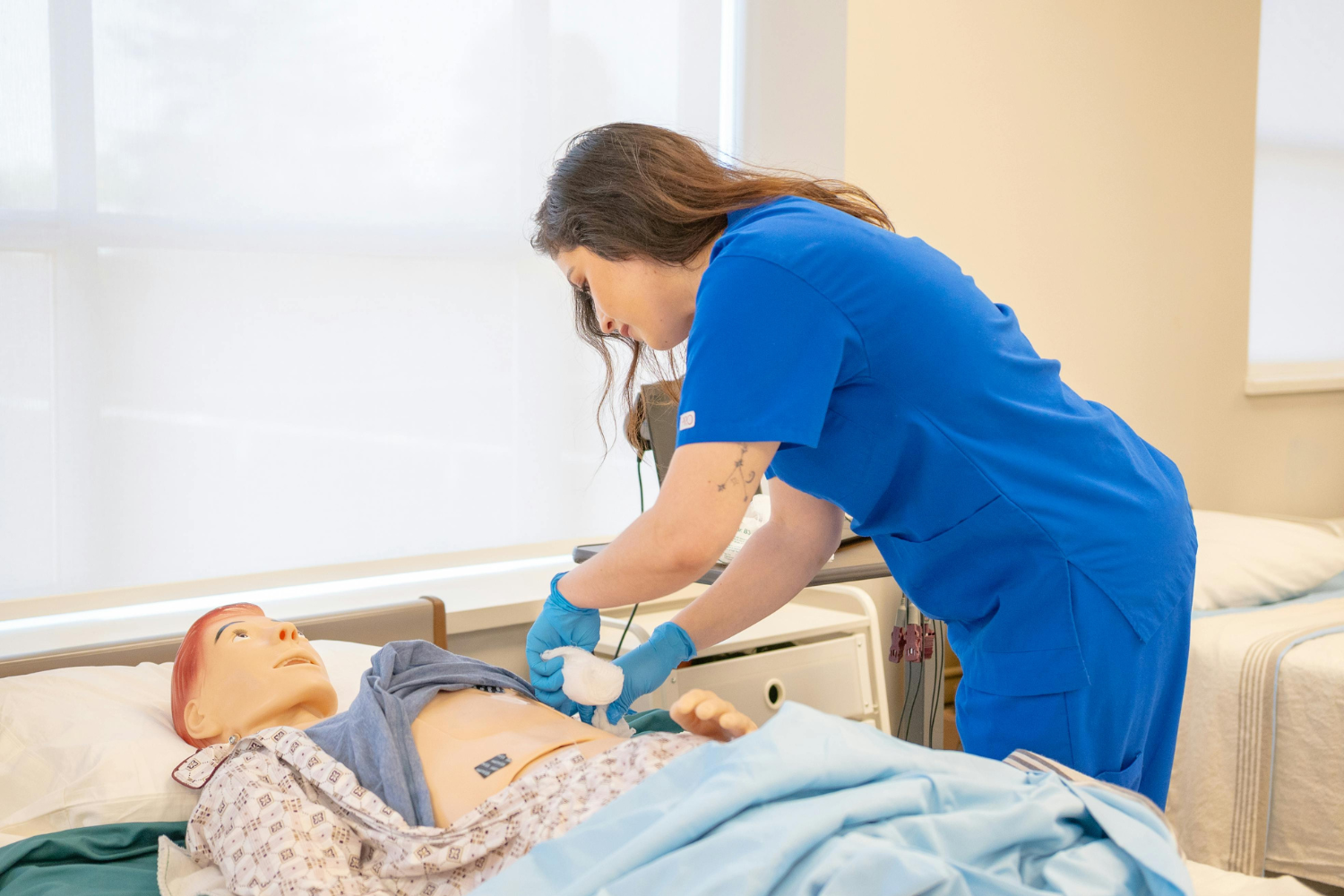
High-fidelity mannequins: simulation equipment that can replicate breathing, sounds, and physiological responses (3 stations for RN/LPN)
Who is in the room:
Each assessment room contains the standardized patient or mannequin, and an assessor who evaluates your performance in real time. You will not be alone in the room. The assessor does not interact with you as part of the scenario — their role is to observe and score. Do not let their presence throw you off. Treat them as you would a nurse manager observing a shift: stay focused on your patient.
Recording:
A camera technician records the assessment from a nearby observation area. Additional people may be present in the observation room for training purposes only — their presence does not affect your scoring. Assessors use recordings to score your performance and they can be reviewed if you request a reconsideration of your results.
The 5-Minute Chart Review: How to Use It Strategically
According to Inspire's How to Prepare page, before each station begins, you receive a patient chart. This contains a brief written statement introducing the clinical problem and the task you are being asked to perform. It also includes supporting documents such as lab results, medication records, vital signs, or care notes — to help you plan your approach.
You have five minutes to review the chart before the simulation scenario starts. Paper is provided for notes, but your notes are not scored.
Those five minutes feel short when you're nervous. Here's how to use them well:
Read the task statement first, not the full chart. Know what you're being asked to do before you try to take in all the clinical detail. The task statement is the anchor for everything else.
Scan for red flags. Look for abnormal vitals, allergies, current medications, and any recent changes in the patient's condition. These are the details that will shape your priorities.
Write a quick priority list. What needs to happen first to keep this patient safe? Use frameworks you know: ABCs, Maslow, safety first to order your thinking. Even a brief mental hierarchy helps you walk in with direction rather than panic.
Note the patient's name. Use it during the encounter. Calling a patient by their name is a small thing that signals patient-centered care, and assessors notice it.
Take a breath before you enter. You will not have another quiet moment until the station ends. Use the last few seconds to settle, not to cram more information.
When You First Enter the Room: What to Do in the First 60 Seconds
The first minute of each station sets the tone for everything that follows. Many IENs focus so much on the clinical task that they rush the opening. That is where marks are lost before the scenario even gets going.
Here is what you should do as soon as you step into the simulation room:
Perform hand hygiene. This is the first thing assessors are watching for. Do it before you touch anything — before you approach the patient, before you pick up equipment. Use the gel or sink provided. Make it deliberate and visible, not a quick gesture on the way to the bed.
Conduct an environmental safety check. Scan the room briefly before approaching the patient. Check that the bed brakes are locked, side rails are in an appropriate position, the call bell is within reach, and there are no obvious hazards. In Canada, environmental safety is part of safe practice — not a bonus step.
Introduce yourself. State your name and your role clearly. "Hi, my name is [name] and I'm your registered nurse today." This is not a formality — it is the foundation of therapeutic communication and patient trust, and it is assessed.
Confirm patient identity. Ask for the patient's name and date of birth and verify it against the chart or wristband. Do this every time, even in a simulation. Patient identification is a core Canadian safety standard and skipping it — even in a hurry — is a safety flag.
Acknowledge the patient before moving into the task. Before you start your assessment or intervention, take a moment to connect. Ask how the patient is feeling. Let them know what you are about to do and why. "I've reviewed your chart and I'd like to assess you now. Is that okay?" This is where therapeutic communication begins — not halfway through the scenario.
Getting these five steps right in the first 60 seconds signals to assessors that you understand Canadian nursing practice from the moment you walk in.
Working With Standardized Patients (Trained Actors)
Standardized patients are trained actors who follow a script designed to be consistent across all candidates. They will respond to your care, answer your questions, and may express pain, confusion, anxiety, or uncertainty depending on the clinical scenario.
They are not trying to trick you. They are there to give you the most realistic patient interaction possible so that assessors can evaluate how you communicate, assess, and respond.
Common things IENs struggle with during standardized patient stations:
Talking at the patient instead of to them — rushing through tasks without acknowledging the person
Skipping the introduction and consent — in Canada, these are not optional steps
Not verbalizing clinical reasoning — assessors can only score what they can see and hear
Freezing when the patient says something unexpected — this happens more often than people expect
Therapeutic communication — this is one of the areas IENs struggle with most. In many countries, nursing communication is task-focused and directive. Canadian nursing practice expects you to acknowledge the patient's emotions, ask open-ended questions, and respond to what the patient is feeling — not just what they are presenting clinically. Phrases like "I can see you're worried — can you tell me more about what you're experiencing?" matter as much as your clinical technique during the scenario.
How to prepare:
Practice your introduction until it feels natural. Every simulated encounter should begin the same way: your name, your role, what you're about to do, and why. Then ask for consent.
If the patient responds with something you didn't anticipate — a question, a complaint, a change in their condition — respond as you would with a real patient. Acknowledge what they said. Don't skip past it to get back to your checklist.
Verbalize your thinking throughout: "I'm going to check your blood pressure now because I want to understand how your body is responding." This kind of narration is not just good communication — it is evidence of clinical judgment, and it is what assessors are listening for.
Practice this out loud, not just in your head. The habit of thinking aloud during a simulation takes deliberate repetition to build.
Working With High-Fidelity Mannequins
Mannequin stations feel different from standardized patient stations. There is no actor to respond to you, no eye contact, no reassurance that you're doing the right thing. The environment is more procedural and can feel more clinical — and for some IENs, more intimidating.
High-fidelity mannequins can simulate physiological responses: breath sounds, pulses, and vital sign changes. Your interventions may produce a visible or audible response.
How to prepare:
Narrate your actions out loud, even though there is no one looking back at you. "I am performing hand hygiene before touching the patient.""I am checking the patient's armband against the medication administration record." This verbal narration is exactly what assessors need to evaluate your reasoning.
Run through skills in real time with a timer. Knowing a skill mentally is not the same as performing it under timed pressure. Your hands need to know what to do.
Do not skip safety steps because there is no live person in front of you. Hand hygiene, patient identification, PPE, and aseptic technique apply at every station — mannequin or actor.
What Assessors Are Actually Looking For
Assessors are not looking for perfection. According to Inspire, the assessment measures your skills against those a Canadian-educated health practitioner is expected to demonstrate upon entry into practice — not against an expert standard.
The four areas consistently evaluated across every SLA station are:
Clinical judgment — how you think, prioritize, and make decisions in real time
Communication — how you interact with the patient, including your use of therapeutic communication and frameworks like I-SBAR when escalating care
Safety — hand hygiene before and after every patient contact, PPE use, aseptic technique, patient identification
Documentation and handover — how clearly and accurately you can communicate clinical information
If assessors cannot hear your reasoning, they cannot score it. This is the most important thing to remember during your SLA: if you are thinking it, say it.
How Long to Prepare — and Why It Matters
Based on what I have seen from working with IENs preparing for the Inspire Global Assessments, I always recommend starting your preparation at least 2 to 3 months before your SLA date. If you are working full-time or managing family responsibilities on top of studying, plan for even more time.
The time and effort spent on preparation directly correlates to performance — and performance directly shapes how long or short your licensure pathway in British Columbia will be. A stronger result means a shorter road to practice. That is not a small thing.
Give yourself enough runway to prepare properly. Don't book your SLA and then start studying. Start studying, then book your SLA when you feel ready.
One important note from Inspire's Fees and Policies page: you have one year from your referral date to complete both assessments, and the CBA and SLA must be completed within three months of each other. Retakes are not permitted except in exceptional circumstances. This is another reason preparation matters — you have one opportunity to show what you know.
After Your SLA: Results and What Happens Next
Inspire does not release a separate result after your SLA. According to the Inspire Competency Assessment Results page, your SLA and CBA results are combined into a single blended performance report, which Inspire sends to BCCNM within 60 days of you completing both assessments.
BCCNM, and not Inspire, makes the registration decision. Inspire's role ends when the report is sent.
If you believe your performance report does not accurately reflect how you performed during the SLA, you can request a reconsideration. Assessors who did not score your original assessment will review the recorded video of your scenarios. A fee of CDN $350 applies. The request must be submitted within 15 days of receiving your report, and Inspire takes approximately 21 days to complete the review. One reconsideration is permitted, and the result is final. Note: reconsideration is available for the SLA only — CBA results cannot be reconsidered.
For a full breakdown of what your Inspire performance report means for your BCCNM registration pathway — including what bridging and transitional education look like — read What Happens After Your Inspire Global Assessments Results.
How to Prepare: A Two-Step Approach
Reading about the SLA and being ready for it are two different things. Here is how Nursing Collective recommends IENs prepare.
Step 1: Build your knowledge and clinical judgment foundation
Before you can perform well in a simulation, you need to understand how Canadian nurses think, prioritize, and communicate — and how the Inspire assessments evaluate those things. Start with one of these two options:
Mastering Canadian Nursing: CBA & SLA Self-Paced Prep Course — study on your own schedule with 500+ CBA practice questions, 10 SLA case scenario lecture videos, Canadian documentation frameworks, and more.
6-Week CBA & SLA Group Coaching Program — everything in the self-paced course, plus 6 weeks of live coaching with Irah Kwok, a Canadian RN with 19 years of clinical and teaching experience, alongside other IENs preparing for the same assessments.
Step 2: Practice in a real simulation environment
Once you have completed Step 1, the In-Person SLA Prep Skills Workshop in Vancouver is where you put it all together.
It's a one-day, small-group workshop led by Irah Kwok. You'll move through simulated SLA scenarios, practice patient interactions with an educator watching and giving real-time feedback, work on your clinical communication, and rehearse the documentation skills assessors are looking for.
The workshop requires completion of any CBA and SLA preparation program as a prerequisite — whether through Nursing Collective or another provider.